Back to Practice

Static Equilibrium & Elasticity

This quiz is designed to help you understand how torque affects objects in attaining static equilibrium.

Intermediate
Question 1 / 157%
0 correct

Question 1

Intermediate

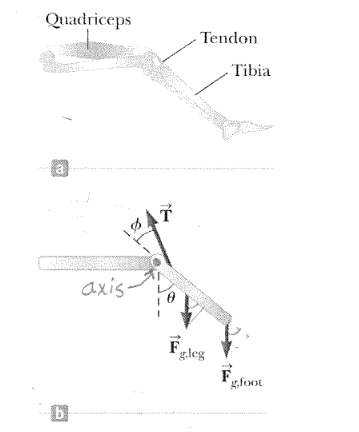
The large quadriceps muscle in the upper leg terminates at its lower end in a tendon attached to the upper end of the tibia. The forces on the lower leg when the leg is extended are modeled as in figure b, where TT is the force in the tendon, Fg,legF_{g,leg} is the gravitational force acting on the lower leg, and Fg,footF_{g,foot} is the gravitational force on the foot. Find TT when the tendon is at an angle of ϕ=25\phi = 25^\circ with the tibia, assuming Fg,leg=30.0NF_{g,leg} = 30.0\,N, Fg,foot=12.5NF_{g,foot} = 12.5\,N, and the leg is extended at an angle θ=40\theta = 40^\circ with respect to the vertical. Also assume the center of gravity of the tibia is at its geometric center and the tendon attaches to the lower leg at a position one-fifth of the way down the leg.

The large quadriceps muscle in the upper leg terminates at its lower end in a tendon attached to the upper end of the tibia. The forces on the lower leg when the leg is extended are modeled as in figure b, where $T$ is the force in the tendon, $F_{g,leg}$  is the gravitational force acting on the lower leg, and $F_{g,foot}$ is the gravitational force on the foot. Find $T$ when the tendon is at an angle of $\phi = 25^\circ$ with the tibia, assuming $F_{g,leg} = 30.0\,N$, $F_{g,foot} = 12.5\,N$, and the leg is extended at an angle $\theta = 40^\circ$ with respect to the vertical. Also assume the center of gravity of the tibia is at its geometric center and the tendon attaches to the lower leg at a position one-fifth of the way down the leg.

Jump to question